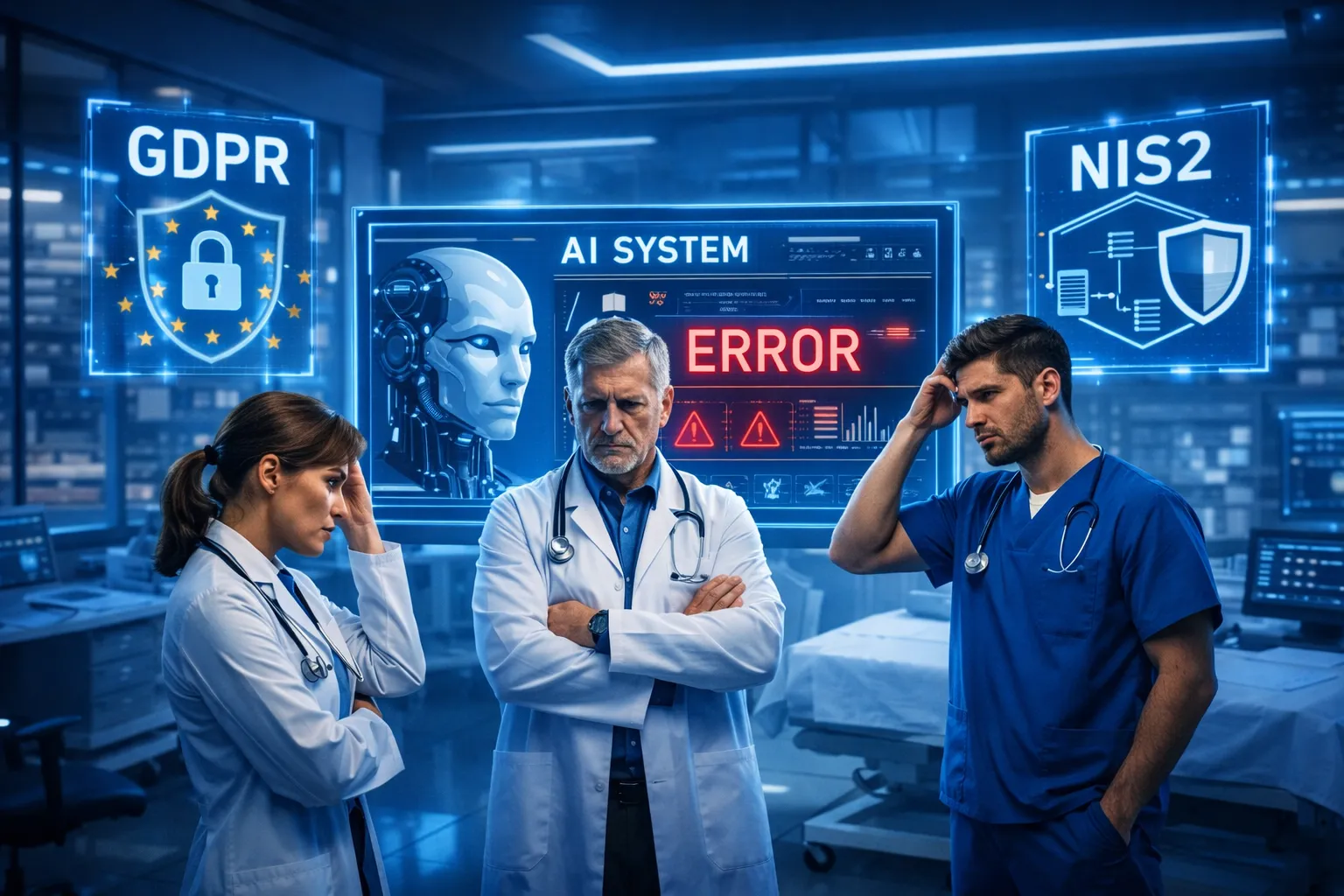
Iată traducerea profesională a articolului în limba engleză, adaptată perfect pentru stilul enterprise și păstrând intactă structura psihologică și impactul textului original:
AI in Hospitals: Solution or Risk? What Happens When You Rely on AI Without Training and Without Reading the Law
In the last two years, hospitals have begun adopting AI at an incredible speed.
Automated triage. Instantly generated reports. Scans processed in seconds.
Everything seems perfect… until the first incident occurs.
The harsh truth is this: AI does not fix a lack of training. AI amplifies a lack of training.
🔵 1. The Dangerous Illusion: "AI Knows Better Than Us"
In hospitals, this illusion appears daily.
Exhausted staff, operating under pressure with cumbersome procedures, look at AI as a shortcut.
But AI:
- Does not know the legislation
- Does not know responsibilities
- Does not know what sensitive data means
- Does not know what is legal and what is not
- Does not know how to stop a human error
AI simply executes.
If a human makes a mistake, AI multiplies that mistake at scale.
🔵 2. Real-World Examples from Hospitals (Anonymous, but 100% Authentic)
- 📌 Case 1 — A nurse who uploaded patient photos into an AI chatbot
- She wanted to "translate a diagnosis faster." The photos ended up on a server outside the EU → GDPR violation, reputational risk, and an internal investigation.
- 📌 Case 2 — A doctor who dictated sensitive data into an AI application
- The AI stored the data in the cloud. The hospital had no DPA (Data Processing Agreement), no consent, and no procedure. The incident was reported to the National Supervisory Authority (ANSPDCP).
- 📌 Case 3 — A manager who asked AI to "write the NIS2 procedure"
- The procedure was incorrect, incomplete, and contrary to the law. The hospital believed they were compliant. During the audit, everything failed.
- 📌 Case 4 — A registrar who entered incorrect data into the AI triage system
- The AI picked up the error and misprioritized patients. Real-world consequences on patient health.
All of these share the same common denominator: Lack of training + Blind trust in AI = Major Risk.
🔵 3. The Legal Risks (Explained Simply)
- GDPR: AI can process sensitive data, but the liability remains with the hospital, not the AI.
- NIS2: AI cannot decide on technical and organizational measures. If the staff does not understand what an "incident," "breach," or "risk" means, AI cannot save the situation.
- Malpractice: Any decision generated by AI but not validated by a human professional becomes the sole responsibility of that human.
🔵 4. Why Do These Problems Arise?
Because three dangerous illusions exist within hospitals:
- "AI knows better than us."
- "AI is faster, therefore it is more accurate."
- "If AI generated it, it's AI's responsibility."
Nothing could be further from the truth. EU legislation is crystal clear: responsibility is 100% human.
🔵 5. The Real Solution: Staff Training
AI can be an extraordinary tool, but only if:
- Staff members know what is allowed and what is not
- Staff completely understand GDPR and NIS2
- Clear procedures are firmly in place
- Human validation is strictly enforced
- Accountability is maintained
Education is the shield. AI is merely the tool.
🔵 6. Memorable Conclusion
AI does not fix a lack of training.
AI amplifies a lack of training.
In hospitals, where every single decision can impact human lives, AI cannot be used by ear. Without education, AI becomes a liability, not progress.