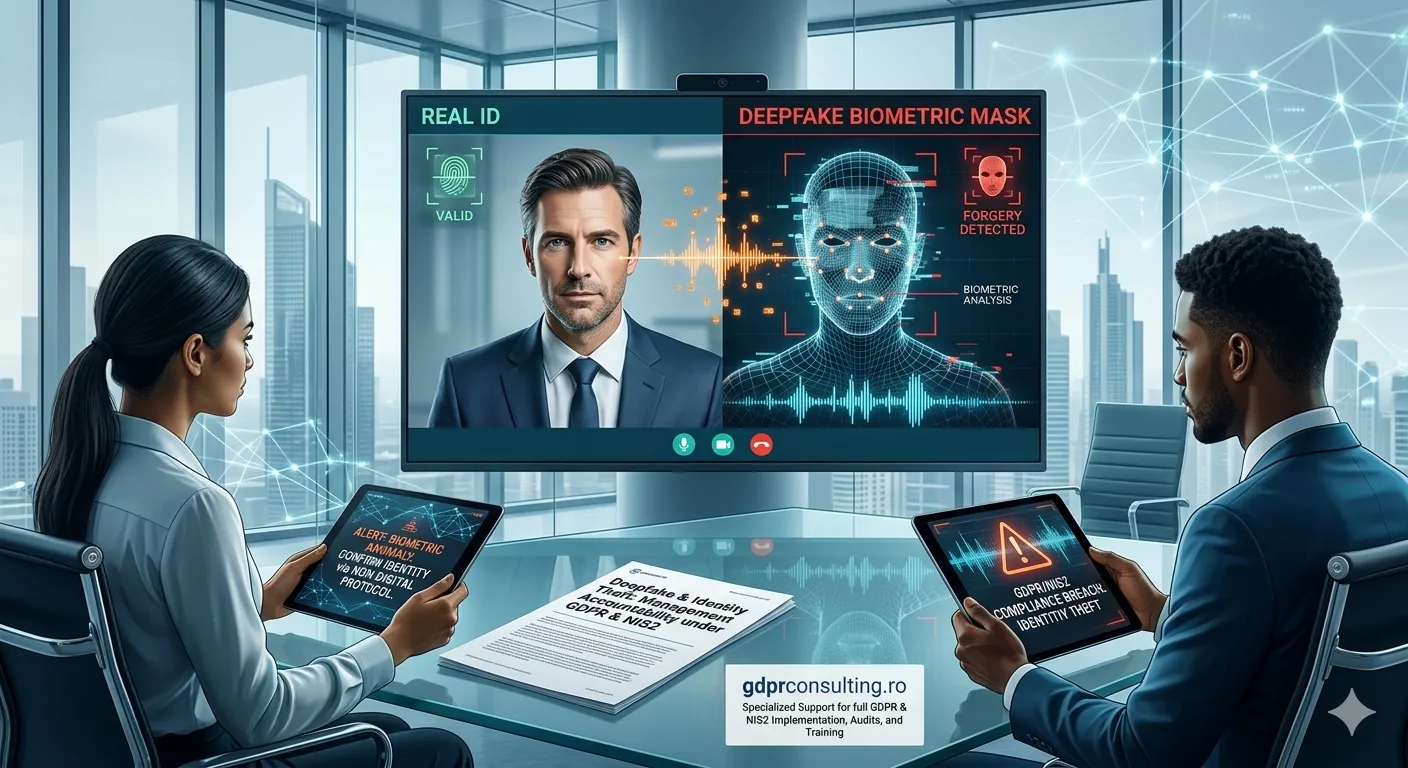
Deepfake: The New Data Breach Paradigm in the AI Era
By 2026, Deepfake technology has transitioned from a theoretical threat to one of the most effective social engineering vectors. From the perspective of European regulations, utilizing an employee's cloned identity is not merely fraud—it is a biometric data breach with significant legal implications under GDPR and the NIS2 Directive.
Identity as Biometric Data
Under GDPR, voice and facial imagery are classified as sensitive biometric data. When an attacker employs an AI model to mimic a staff member's identity, it constitutes the unlawful processing of biometric data. Should this lead to unauthorized access to other sensitive company assets, the organization is mandated to notify the supervisory authority within 72 hours, assessing the risk to the rights and freedoms of the individuals involved.
Management Accountability under NIS2
The NIS2 Directive raises the bar for accountability. Management must demonstrate that they have approved and overseen appropriate risk management measures. In a Deepfake-based incident, the core issue is often not whether the software failed, but whether internal validation and training processes were robust enough to prevent human error.
Pillars of Prevention: Documentation and Training
Preventing these risks is not solely a cybersecurity issue; it is a data governance challenge. An organization’s resilience is built upon:
- Rigorous Validation Procedures: Creating decision-making workflows that include non-digital multi-factor verification for critical actions.
- Compliance Auditing: Identifying vulnerable points in the information circuit where digital identity can be exploited.
- Staff Training: The only effective barrier against Deepfakes is an informed employee, capable of applying safety protocols when technological sensors are bypassed.